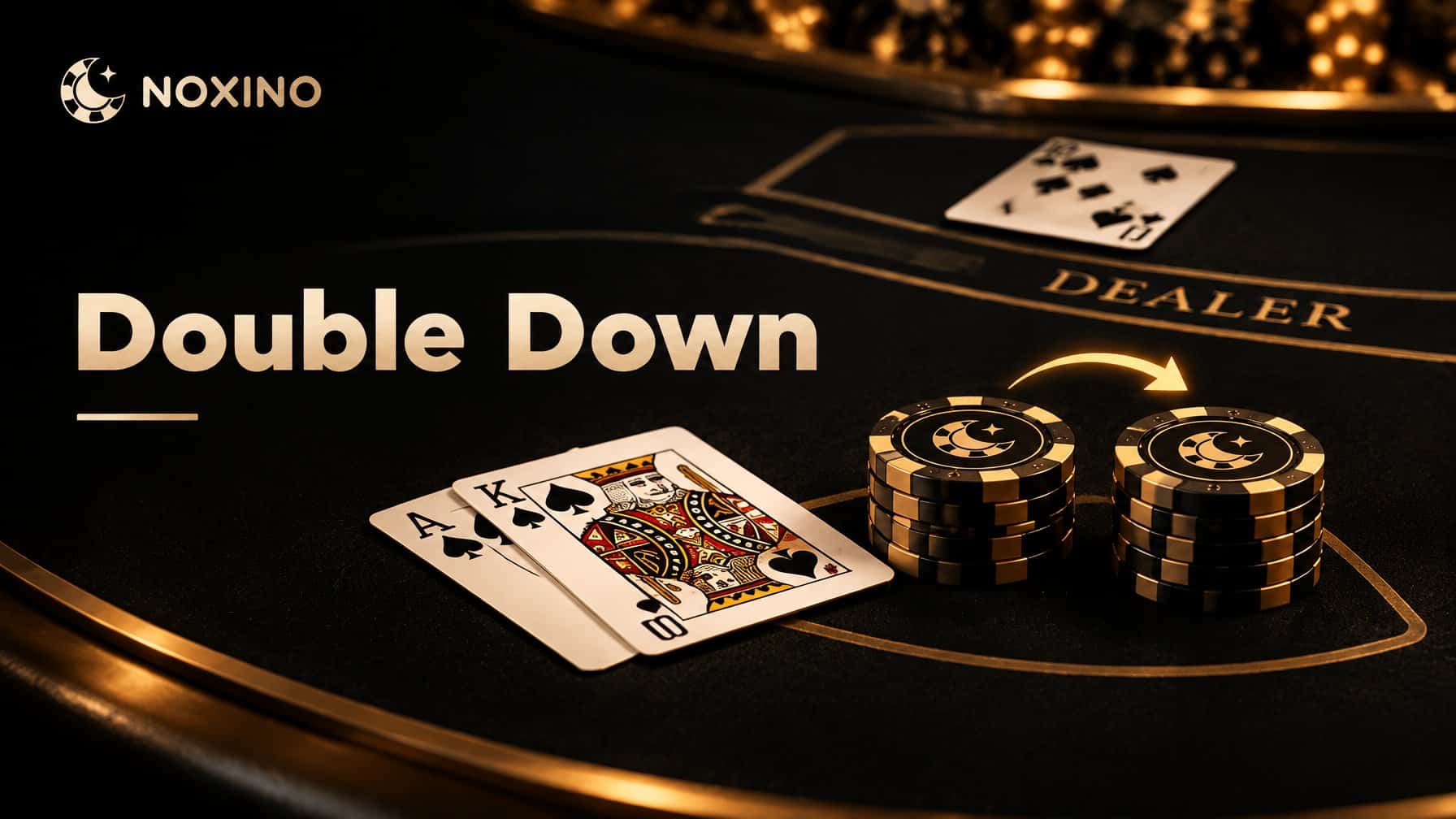
A Double Down can give a promising blackjack hand a little extra punch but only when you choose the moment wisely. It’s a powerful move, and an easy one to misuse if you don’t know the rules.
This Noxino guide shows you how to make the call with confidence. Learn which hands are eligible, how to place the extra bet, and what to check before you act. You’ll also get a handy reference chart and see how a double can lead to either a win or a loss.
Doubling Down: What It Actually Is
To Double Down means matching your original bet after your first two cards, then taking exactly one more card before your turn ends. You’re putting more chips on the table, so there’s no chance to hit again if that card doesn’t help.
Why take the risk? Some starting hands give you a better mathematical chance against the dealer. When you understand the move, you’ll be better equipped to browse casino games and spot tables whose rules suit your play.
The Rules That Govern It
You can usually Double Down only after receiving your first two cards and before you hit. Once you take another card, that option is off the table.
Rules vary by casino and game. Some tables let you double on any two cards; others limit it to certain totals. Check the table rules before you play, and review any bonus offers carefully to see whether they suit your plans.
Splitting a Pair, Then Doubling
Some blackjack games let you double down after splitting a pair. This is called Double After Split, or DAS. Once your pair becomes two separate hands, you may be able to add an extra bet to one of them after seeing its first two cards.
DAS gives you more flexibility because each split hand can be assessed on its own. Whether it’s a good option depends on the cards, dealer’s upcard, and table rules, so check before counting on it.
Timing the Double Correctly
The best time to double depends on the kind of hand you’re holding. A hard hand has no ace counted as 11, while a soft hand does. Each plays by different logic, so let’s look at them separately.

Hard Hands Worth Doubling
With a hard hand, the total can’t adjust if your next card is too high. That makes the dealer’s upcard especially important. Hard 9, 10, and 11 are common doubling candidates because a 10-value card—10, Jack, Queen, or King—appears frequently in the deck.
Against a dealer’s weaker card, that extra card may give you a strong total while the dealer faces more risk. Under a commonly used basic-strategy chart for multi-deck blackjack, typical doubles include:
- Hard 9: Double against dealer 3–6.
- Hard 10: Double against dealer 2–9.
- Hard 11: Double against dealer 2–10; the recommendation can vary against an ace.
These are general guidelines, not universal rules. The best play depends on the game’s rules, so use a strategy chart matched to your table.
Soft Hands Worth Doubling
A soft hand contains an ace counted as 11, such as ace–6. If a high card would push the total over 21, the ace can switch to 1. That flexibility makes a soft-hand double less risky than it may first seem but you still receive only one card.
In a common multi-deck basic-strategy chart, typical soft-hand doubles include:
- Soft 13 or 14: Double against dealer 5–6.
- Soft 15 or 16: Double against dealer 4–6.
- Soft 17: Double against dealer 3–6.
- Soft 18: Double against dealer 3–6; other upcards may call for a different move.
Rules can change these recommendations, especially for soft 18. Check a strategy chart that matches the number of decks and whether the dealer hits or stands on soft 17.
A Fast Reference Chart
Need a quick reminder while you play? This chart sums up common double-down spots for multi-deck blackjack. Rules can vary, so check your table’s strategy guide before making a move.
| Your Hand Total | Dealer’s Upcard | Action |
| Hard 9 | 3-6 | Double |
| Hard 10 | 2-9 | Double |
| Hard 11 | 2-10 | Double |
| Soft 13 or 14 | 5-6 | Double |
| Soft 15 or 16 | 4-6 | Double |
| Soft 17 or 18 | 3-6 | Double |
How the Move Plays Out
At a live blackjack table, doubling down means placing an extra wager equal to your original bet. Set the chips beside your first stack—not on top of it—so the dealer can see the two bets clearly.
Then signal your choice according to the table’s rules. In many games, players tap the table to hit and place a finger beside the wager to double, but gestures can vary.
The dealer gives you exactly one card, usually placed sideways to mark the doubled hand. Once it arrives, your turn is over: you must stand, even if the total isn’t what you hoped for.
When to Skip the Double
A hand may qualify for a double, but that doesn’t mean it’s always the best play. The dealer’s upcard can change the odds: a 10 or ace is strong, so doubling into one may be less appealing than doubling against a weaker card.
Be cautious with totals that can easily bust after one card. A hard 12 or higher, for example, can go over 21 with a 10-value card. These hands generally aren’t standard doubles under basic strategy.
Don’t add a second wager just because you’re eager to turn the hand around. Check a strategy chart that matches the table, then follow its recommendation.

Playing the Odds Consistently
Good blackjack habits make it easier to stick with sound decisions, even when a hand gets tense. Keep these three in mind:
- Use a basic-strategy chart matched to your game’s rules.
- Set a budget that can handle the doubled wager, and never bet money you can’t afford to lose.
- Make each decision on the current hand, not on a win or loss from the last one.
No chart can promise a win. It can help you make more consistent choices over time.
Errors That Add Up Fast
Two common mistakes can quietly undermine your play. Doubling on instinct because a hand “feels lucky,” for example—can lead you to add money in matchups where the dealer has the advantage.
The opposite mistake is passing on a recommended double out of fear. One missed decision may not seem important, but repeating it can mean missing favorable opportunities over many hands.
Use your chart instead of your gut, and remember: a sound decision can still lose on the next card.
Two Hands, Two Different Results
A Double Down can turn a strong position into a satisfying win or a bigger loss. The move raises your wager, but it never guarantees what the next card will bring.
Example 1: The double wins. You bet $10 and receive a 5 and a 6, making 11. The dealer shows a 6. You double by adding another $10, then draw a 10-value card for 21. The dealer finishes with 17, so you win $20 in profit on your $20 wager.
Example 2: The double loses. You again bet $10 with a hard 11 against the dealer’s 6. Doubling is a reasonable play, so you add $10. This time, you draw a 2 and finish on 13. The dealer makes 18, and you lose the full $20 wager.
The second result doesn’t mean the decision was wrong. A sound double can lose; judge the choice by the situation, not by one card.
Why Hesitation Is the Costlier Choice
If a strategy chart recommends doubling, hitting instead doesn’t remove the risk. You still have to play the hand, you’re simply giving up the chance to earn more when the matchup is favorable.
It can feel uncomfortable to add money, especially after a loss. But following a chart that matches the table rules helps keep decisions consistent. Trust the process, set sensible limits, and avoid letting fear or frustration turn strategy into guesswork.
What’s Different About Doubling Down Online?
At a casino table, you place extra chips beside your original bet and let the dealer know you’re doubling. Online, just click or tap Double or Double Down. The game adds an equal wager and deals you exactly one more card.
Playing with a live dealer? Choose the on-screen button when it’s your turn. In an automated game, the software handles the deal. Either way, use the same approach: check your hand, the dealer’s upcard, and the table rules before committing to the extra bet.
Double Down: Quick Questions
Doubling Down is when you add a bet equal to your original wager after your first two cards and take just one more card. Your turn then ends, so weigh your hand against the dealer’s upcard before committing.
Not always. Doubling on 11 is often recommended, but the best choice depends on the dealer’s upcard and the table rules. Check a strategy chart for your specific game before deciding.
Your wager is doubled, and you receive one final card, no more hits afterward. Once your turn is over, the dealer plays their hand, and the winner is determined by comparing the totals.
Sometimes, it depends on the table. If it allows Double After Split, you may be able to double a newly created hand after splitting. Check the rules first, as this option isn’t available in every game.
No, Doubling Down raises both your potential win and the amount you could lose. A smart decision can still end in defeat because blackjack outcomes are uncertain. Follow a suitable strategy and stick to your budget.